
Employers and Reentrants Benefit from Initiatives to Lower Recidivism

By Lainey Stalnaker, Data Analytics Writer
Over the last decade, South Carolina has maintained one of the lowest recidivism rates in the country. This achievement is the result of continued collaboration between state agencies, employers, and nonprofits to reintegrate formerly incarcerated individuals into society, a process that often begins with employment services, such as training and networking with employers to find job opportunities even before release. Justice-involved individuals face unique challenges in the job market, and South Carolina has improved recidivism rates in part by addressing these challenges early on in the rehabilitation process. April is Second Chance Awareness Month and our agency’s Spring into Employment monthly initiative, which is an opportune time to highlight the ways that employers can benefit from hiring jobseekers, such as justice-involved individuals, who experience barriers to employment.
What is recidivism?
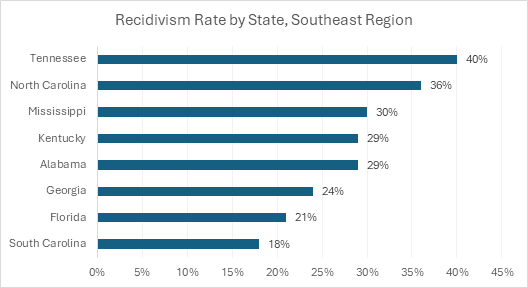
Recidivism refers to an offender’s relapse into criminal behavior. South Carolina, like most states, defines the recidivism rate as the percentage of criminal offenders who are reincarcerated within three years of being released from prison. In 2019, South Carolina’s recidivism rate was 18 percent, tied for the third lowest in the nation, and down from 31 percent in 2008.1 The figure below shows the most recently available recidivism rates for states in the Southeast region.
The Department of Corrections (SCDC) and Department of Employment and Workforce (DEW) collaborate to administer the Second Chance Program, which helps returning citizens learn job skills and successfully reenter the labor force.
What resources are available for reentrants and their employers?
Resources exist at every step of the reentry process, including creating a resume, searching for job openings, preparing for interviews, and being hired. For returning citizens, DEW career consultants at SC Works centers throughout the state can help with the job search and interview preparation. DEW also partners with SCDC to provide services directly to those who are about to be released while they are still within a correctional facility, including mock interviews with our agency’s career specialists and participating employers, as well as training to prepare them for reentry to the workforce, including technical and occupational courses, as well as soft skills training.
The Federal Bonding Program incentivizes employers to hire returning citizens. This program provides coverage for high-risk jobseekers, including formerly incarcerated individuals. The program provides free $5,000 fidelity bonds to employers who hire high-risk individuals, which serves as insurance in the event that an employee commits a dishonest act resulting in monetary loss. Interested employers can contact Amy Hill at FederalBonding@dew.sc.gov.
The Work Opportunity Tax Credit (WOTC) is another incentive for employers to hire individuals who face barriers to employment. Employers can receive a tax credit of up to $2,400 if they hire an individual who was formerly incarcerated or convicted of a felony. Those who want to learn more can reach out to the WOTC department at WOTC@dew.sc.gov.
South Carolina’s reduction in recidivism is the result of consistent efforts made by stakeholders across the state. Employers can carry on this success by taking advantage of these programs and connecting reentrants with stable employment.