
Prime-Age Labor Force Participation: South Carolina Reports Gains in 2025

By Lainey Stalnaker, Data Analytics Writer
According to the U.S. Bureau of Labor Statistics, from 2024 to 2025, the average prime-age labor force participation rate (LFPR) in South Carolina increased 1.6 points from 81.1 percent to 82.7 percent.[1] Prime-age LFPR is the proportion of the population aged 25-54 that are either employed or seeking employment. As the name suggests, this group is the most likely to be in the labor force, as those younger than 25 are more likely to be in school, and those older than 54 are more likely to be retired. An uptick in labor force participation among this group suggests that the people we expect to be working or seeking work are in fact doing so—a clear signal of the strength of the state’s job market.
South Carolina’s prime-age LFPR has been rising steadily in recent years. In 2025, the average prime-age LFPR was just 0.9 points lower than the U.S. average, an improvement on a difference of 2.5 points in 2024. Outcomes were even better for people in the 16-24 age group. People between the ages of 20 and 24 years old had the same LFPR in South Carolina and in the United States. Among 16-to-19-year-olds, the LFPR in South Carolina exceeded the national average by 2.5 points. The rate by age group is shown in the figure below.[2]
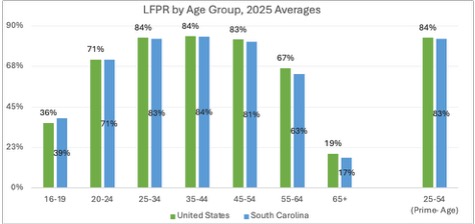
Although labor force participation is higher in the U.S. than in South Carolina for most age groups, South Carolina has made progress in closing these gaps, which is most evident among younger cohorts. Additionally, the prime-age LFPR in South Carolina exceeds rates in all other states in the Southeast region, which include Alabama, Florida, Georgia, Kentucky, Mississippi, North Carolina, and Tennessee.[3]
[1]https://www.bls.gov/lau/ptable14afull2025.htm
[2]https://www.bls.gov/lau/ptable14full2025.htm
[3] The Southeast region is defined by the Department of Labor.