
South Region Reports Slower Inflation in April 2026 Compared to National Average

By Lainey Stalnaker, Data Analytics Writer
The Consumer Price Index (CPI), published by the Bureau of Labor Statistics (BLS) each month, measures the average change in prices paid by urban consumers for a broad range of goods and services — including food, energy, housing, transportation, medical services, recreation, and education. The percent change in the CPI over a 12-month period is the most common measure of inflation in the United States. The CPI is available for the U.S. and specific regions, including the South.
The figure below shows CPI growth in the U.S. and in the South region. Between April 2025 and April 2026, the U.S. CPI increased at a rate of 3.8 percent. The South region’s CPI growth rate was 3.6 percent. Compared to the U.S., the South region CPI has been increasing at a slower rate for nearly two years.
Also shown in the figure below is the core CPI growth rate, which excludes food and energy prices, as they are typically more volatile and can skew the overall trend in price changes. U.S. core CPI increased 2.8 percent from April 2025 to April 2026. In the South region, core CPI increased 2.4 percent. This means that the prices of items which are typically more stable, such as housing, medical services, and transportation, are increasing at a faster rate in the U.S. than in the South.
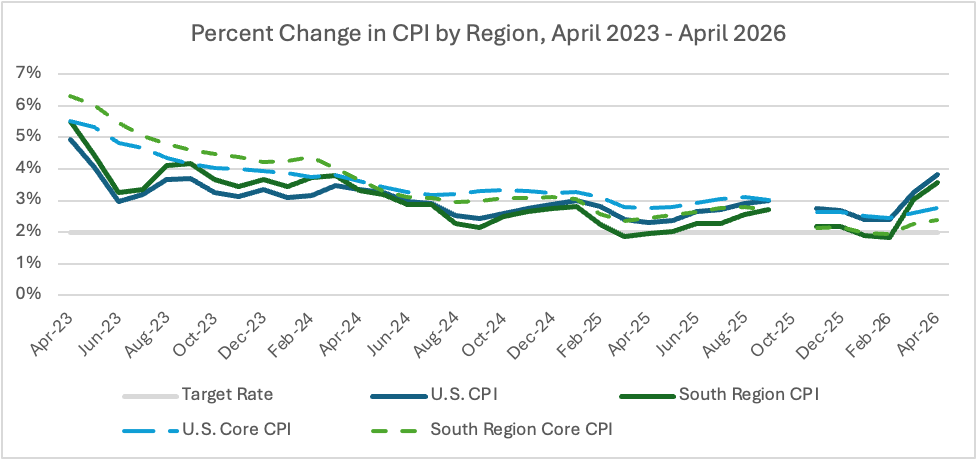
- https://www.bls.gov/regions/southeast/cpi-summary/ro4xg01a.htm
- The South region comprises Alabama, Arkansas, Delaware, District of Columbia, Florida, Georgia, Kentucky, Louisiana, Maryland, Mississippi, North Carolina, Oklahoma, South Carolina, Tennessee, Texas, Virginia, and West Virginia.